Showing posts with label powerpoint. Show all posts

Powerpointing My Office

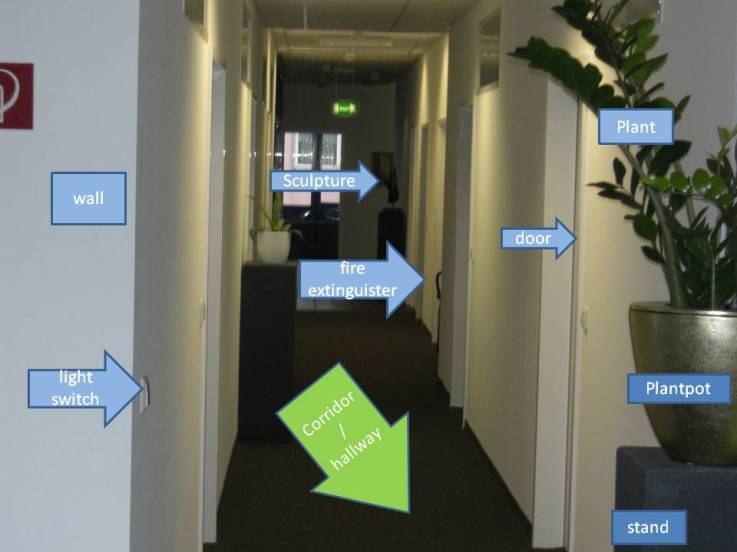
It goes without saying that any good beginner level (and many elementary) coursebook has a picture appropriately labeled to tell the students what everything is.   If it's aimed at general learners, it'll be the kitchen or the bathroom or perhaps all the rooms in a house.  If it's aimed at Business English students or ESP learners, it'll be common instruments they probably come into contact frequently.

But here's the thing... why use someone else's picture when your students actually live in houses, work in offices or manufacture on site?


My tech-tip to bypass the coursebook or rather personalize it, if you wish, is this:

1. Ask students to take photographs of the room they need to describe or refer to in common speech. In the example above, we've used an office.  By the way, these were taken with Torsten's mobile phone.

2. Get your students to load the pictures up into a Powerpoint document.

3. Ask them to now work in groups to share each others best guesses at what things are before checking their dictionaries (online/on the phone/in hard copy).  

If you're working individually, as I am in this case (not many beginner level students in Germany!), talk through the items together, ensuring that the student does most of the work, using words he's already come in contact with before and look up others together, rather than you giving him all the answers.  

4. Ensure that your student(s) do all the labeling themselves.  

5. If you're working on an online platform with students, you can also jpeg the slides and upload them into a common album.


Why is this such an amazing resource?

Aside from the fact it's a very personal photograph and therefore has a real and immediate relationship to the learner and his needs, you can use these pictures/Powerpoint slides, repetitively, to
  • practice articles
  • practice this and that, these and those
  • practice prepositions
  • discuss functions of items
  • review vocabulary
What other things could you get your own language learners taking pictures of and labeling?  What other language functions can these pictures help practice?


Have you ever tried anything like this?   How did it go?   Do you think that the pfaffing involved is setting something like this up is prohibitory (it took us about 10 minutes to go around the building snapping pictures... about 5 minutes to load the pictures from his phone into Powerpoint but then I needed to teach him how to make boxes and label, that was about another 10 minutes - I'd refused to give the instructions in German) - we did this about a month ago and his feedback was that he knows the words because he 'sees' them whenever he looks at things in the office now.


Useful links related to this posting: 

Best,
Karenne

Cartoon Videos in Business and Financial English

With all the hullabaloo going on in Europe, Greece first and now Italy plus wherever's next by the time this post is actually published... because according to my students it was always going to be a W recession and now that the Euro is sinking fast, Friedmann-type prophecies threaten, whispers of deflation scatter, so  thought I'd better get on with posting up this interesting video I've done with my own ESP:Financial adult learners.


My own lesson plan with a Pre-intermediate group was based on taking the vocabulary presented in Ian MacKenzie's book, Financial English, and turning it into something a wee bit more exciting & communicative, ensuring that the vocabulary included some stickiness and of course, making it somewhat easier-to-swallow.

So...
a) we watched the video
b) did the exercise 6.10
c) watched the video again and discussed it for merit and content
d) got them to explain inflation and deflation
e) reviewed the questions on 6.10
d) talked through European periods of inflation and deflation
e) they created their own Powerpoint slides of the vocabulary in 6.10 (in exercise and text)

Would you have done this lesson any differently?

What other ways could this video (or the ones below) be used?


Best,Karenne


More Cartoon Videos for Business English (a playlist)


Useful links related to this posting: 
Business English Cartoons (Youtube link to the ones shown above)
The Dilbert channel on Youtube
Business English Pod
More video websites for Business English 
More Financial English tips

Powerpointing Grammar - EFL Tech Tip #13b

One of my favourite quotes is :

The art of teaching is the art of assisting discovery.
Mark Van Doren


PowerPoint is one of those tools - really not quite as fancy as the vast majority of web2.0 tools out there at the moment but, nonetheless, still a favorite for achieving the above effectively.

I'm sure you've already done this sort of exercise with your own students - handing over content control - probably using great big A3 sheets of paper and giant markers all throughout your career ;-) so I won't belabor the point but simply head straight on to an example of student work:

The Dark Past


Procedure

  • Group a few students together and encourage each group to decide on one particular grammar point or series of points they would like to be in charge of.  This is especially useful close to an exam when they need a review or at the end of a course.  
  • Using books or the internet, they should check on their understanding of the explanations and, most importantly, must decide collaboratively how to explain this information in the simplest way within their own presentations.  
  • Using Powerpoint (or any similar software) they then create the slides, adding pictures, graphics, sound or videos (or whatever else).
  • Let them choose who will be the teacher for each group and if you have a beamer (data projector) beam their presentation on the wall, if not, print out.


Sharing


If you're using a Ning or other community based platform either upload the presentation directly into it or upload them into a file-sharing website like Scribd.com or Slideshare.net.


Alternatively, distribute copies via email so that all copies can be revised at home - encourage questions and examples a few days later, after the presentation has finished.

Update June 2010, a simpler student example:

Prepositions of Place 1

Best,
Karenne

Useful links related to this posting:
Powerpointing me, tech tip 13a
Seth Dickens version of Powerpointing me
Using Powerpoint when teaching metaphors in Financial English

Coming soon: 
Powerpointing Lexical Sets 13c
Powerpointing Country Guides 13d


Have you tried this sort of activity with students?  How much error-correction  or other meddling do you do  - what about if you see a strange choice of images or an incorrect explanation?

And, by the way, if you've got another great Powerpoint activity suggestion don't hesitate to share your tricks and tips with us by explaining in the comments or if you've blogged it, do add your url.   (Or consider writing a guest piece for this blog on the subject! :-))

Powerpointing Me -EFL Tech Tip #13

The other day when I was reading Nick Jaworski's blog postings on using the Teacher as the Narrative in EFL classes, I left a comment behind regarding one of my used-a-gazillion-times-first-lessons...


The Getting to Know You, Getting to Know Me game

I've no idea where I originally picked up the bones of this before techitizing it for my own purposes, so 'xcuse me if I don't reference the source - however, if you know, let us all know below.


Objective

  • Create an atmosphere of sharing right from the get-go.
  • Find out your students' communicative abilities and weaknesses: particularly when making small talk /asking and answering questions.

Prep
  • Approx 2 - 4 hours, depending which option you choose below. However you'll be able to use it an infinite number of times in an infinite number of (first day) lessons for an infinite number of years.

Brainstorm

Who are you?
Jot down quick notes on words that describe you and your life.
  • country of birth
  • countries lived in
  • marital status
  • family & siblings
  • current job
  • previous jobs
  • a job you dreamed of having
  • degree(s)/ other studies
  • hobbies and interests
  • group/ associations you belong to
  • places you've been on holiday
  • your age (number)
  • how long you've been teaching (number)
  • your house number
  • fave food /drink
  • fave music /musicians
  • fave book(s)
  • something unusual about you
  • anything else you feel like sharing


Procedure Option 1 (no tech, photocopier optional)
  • Dig out photos that match the above list, clip pics out of a magazine
  • Type the numbers using a large font and print
  • Photocopy the pics to A4 if you'd like them to be uniformed in appearance
  • Stick on to colored card and laminate


Procedure
Option 2 (low tech)
  • Open up a PowerPoint document
  • Insert personal pictures from your computer
  • Search www.flickr.com or google images (cc-licensed*) for the images/maps you don't have yourself - import these into your ppt.
  • Type the numbers in a large font.


Procedure Option 3
(medium tech - quickest)
  • Go to Wordle.net
  • Enter the words you brainstormed
  • Print several copies of your wordle & laminate (or capture as a jpeg / insert into a ppt slide)


Procedure Option 4
(will take >4hrs)
  • PhotoPeach your life. Use with intermediate learners+ re fast imagery.
  • Same as option 2
  • Save all slides as jpegs
  • Upload into Photopeach
  • Select music: something related to your own culture or fave band works best.

PhotoPeachingMe on PhotoPeach


NB. It doesn't matter what order you present your images in.


In class


After briefly introducing yourself to your new students and getting their names, ask if they know anything about you and if they'd like to.
Optional: depending on your students' levels you may like to review question structures (wh-q/auxiliary and modals/conditionals/present-perfect) prior to doing this exercise, but not necessary.

Tell your students you're going to show some pictures and you'd like them to guess what the images have to do with your life by asking you questions.

Show the first picture / beam the first slide / show the first 30secs of movie.

Once you've elicited the correct answer, elicit the best question form which would produce that answer.

A rough example:
Picture: A boy and girl which look like me
Teacher: What does this have to do with me?
Students: "Brothers and sister?"
Teacher: How can you make that into a good question?
Students: "Do you have brother and sister?"
Teacher: Brothers and sisters are called siblings, you can also ask "Are they your brother and sister?"
Students: "Do you have (any) siblings?"
Teacher: Yes, I do. I have 2 brothers and a sister. My little brother wasn't born yet - in this picture - he's only 19. Do you have any questions about them?
Students: "Where they live?"
Teacher: Where do they live
etc...

Show the rest of the pictures or slides and continue getting students to ask about your life.

If you chose the movie option, show the whole film and then get students to ask questions about your life based on the images they've seen.

If you chose the Wordle option, get students to work in groups to figure out what the words might have to do with your life before getting them to ask the questions.


Their turn

Get students to jot down 5- 10 questions they'd like to ask each other. Circulate and correct their structures and vocabulary.

Form pairs or small groups and encourage them to ask each other about each others lives.

After around 15 minutes, switch members of groups and now ask them to tell their new partners about the lives of those they were talking to, as well as themselves. Depending on the size of your class, you can repeat this step as often as you like.


Post task

Students can create their own powerpoint presentations, wordles or movies based on what they're able to learn from the internet and/or other sources regarding one or more of the following:

  • politicians /local or international
  • sports figures
  • entertainers: singers, movie stars, tv personalities
  • their googlegänger
  • anyone else

Ask students to bring what they learned to the next class in order to present it - share and discuss what they learned - again encouraging them to ask each other to ask questions & prompting for extended answers.


Useful links related to this posting:

Getting to know you, video with lyrics (can be used pre-task)
Getting to know you introduction games
Getting to know you - conversation prompt cards (available free to registered members of my website).


Do you have any questions or a creative tip for first lessons that you'd like to share with us?

Best,
Karenne

Note: you can print these lesson tips as a pdf by clicking on the title of the post, scrolling down and then clicking on the green "print as pdf" button.

Water Words (on using images in ESP: Financial English)

Financial English Ian MacKenzie
One of the absolute best supplementary books to use when teaching banking or financial types is Financial English by Ian MacKenzie.


However, despite the absolute wealth of vocabulary it contains, the exercises can be a bit difficult for students to do, especially if they've never seen the words before and also the book is, quite frankly, a wee dry.

If you've been reading my blog for a while then you've probably already gleaned by now that I like to have a bit of fun in my lessons... and I've noticed you do too... while still sticking to the core learning objectives.

trickle downSo in this posting I'm going to hone in on two different approaches to working with lists of words, when presenting a visual lexis.

For this example, we'll look at the language in unit 2.10 of Financial English, Liquid Metaphors.


Step one:
Divide up the following words by the number of students you have:

2.10 includes:
channel, dry up, flood, flow, pour, run out of, swim, trickle down, drain, ebb and flow, pool, source, awash, crest, depth, under(water), fluid, sank, plug.


*To mix things up, I also brainstorm a list of related lexis with my students and provide extras before evenly distributing these amongst the students e.g. (water)fall, drop, river, cross that bridge, laundry, ocean, wave & drown.

brainstorming


Step two (the dogme version)

drawing
Hand out the vocabulary and ask your students to draw pictures matching each word.


drawing

As great masterpieces aren't expected, you'd be surprised how much 50+ year old bankers enjoy doing this type of activity, LOL!


drawing
For the words they have difficulty drawing (because they don't know them) either encourage them to help each other out, mime the words or allow them to use a dictionary.


OR


Step two (the techno-teacher version)


Give your students their share of the words and set image searching as their pre-task activity.

They can use Google images (use safe search), any photo based web 2.0 platform and/or my personal favorite, flickr. Remind them to look for images that are creative commons licensed.

Ask them to copy the pictures into Powerpoint, create slides & label if wished.

n.b. if you don't have a computer in the classroom this pre-task can be set as a home based activity.


powerpointStep three

Spread the pictures across the table or if you have one, pin them up on a corkboard.

Encourage your students to present their drawings or slides and to share their understanding of the words they've learned with each other.


Step four


Do the exercise provided by the book* - if feasible, get them working in pairs of groups discussing the different solutions applying the words to a financial context, referencing the pictures on the table.

*obviously although I'm using Financial English as the example here, you can do this activity with any vocabulary book.


awarenessStep five

Build awareness by highlighting and discussing the common expresssions i.e. trickle down, run out of, riding on the crest of a wave, pulling the plug on something, a huge pool of resources etc - encourage them to come up with alternative sentences using these.


Step six


Now ask your students to write up a short essay reusing the metaphors. For example, in this case, they could describe:

  • their company's financial situation
  • a project they're currently working on
  • their country's economy
  • the financial crisis and the global economy
  • a current financial news item (e.g. a company heading toward bankruptcy or being listed on the stock exchange)
essay


Step seven


Correct their pieces and get them to share what they wrote with each other - encourage further conversation on the opinions stated - reusing the collocative phrases as often as possible.

Best,
Karenne

Side note: I've done both of these methods with my learners and they all reported 1) increased awareness of the vocabulary and 2) a noticing of the lexis in later financial news articles.

For me, these approaches of working with images, while similar probably have different effects on memory.

I've been thinking about it and reckon that they probably trigger different learning processes (one involves some physical learning and discovery of the lexis, the image searching would result in immediate association between the word and image) however, honestly, as I'm not a scientist nor do I have a masters in second language acquisition, I'd really love to know your professional take on this issue.

Do you know of supportive texts that back these ideas up?

Have you/would you also do this type of activity with kids or teens? Why, why not?


Useful links related to this posting:


  • The Weboword Ning - for vocabulary enthusiasts, lovers and learners! This is the world's first community dedicated to Visual Vocabulary.
 

Visitors and Regular Readers

Facebook

FEEDJIT Live Traffic Feed

Communities of Practice

Directories, catalogs and Back Links

Adult Blogs - Blog Catalog Blog Directory Add to Technorati Favorites


The EFL ESL Blog List TotalESL.com - ESL/EFL/TEFL Teaching Jobs and Teacher Resumes

International Blogging Directory

Recent Posts

Simply Conversations

Pedagogically sound materials designed to get your students actively talking:

Free Samples
Conversation Control

Shop
General English
Business English
ESP


Learn more on why these work