I had something very different scheduled for today.
(I am now blogging on Tuesdays, Thursdays and Sundays).
However a little while ago I followed a link from a brand new follower on Twitter, Tilly Harrison, and the link she sent out into her stream defied all my pre-conceptions of the universe.
It blew my mind away. Completely.
Actually I think I may have woken up on the wrong planet.
Friends, Earth is changing.
The way we learn is changing. The way we communicate is changing. And it's all happening so very, very quickly. No wonder people are afraid or worried. No wonder there's so much resistance to bringing tech into our lessons - today, confession, I too need a strong espresso after watching Lade's Directed transport without net bias in physics and biology... and understanding what he was on about.
So if you happen to know anyone who doubts, for even a minute, that we are not on the very cusp of an entirely different way of doing things in the process of becoming educated and that all of this isn't going to wind up effecting our own special niche areas, then tell them please stop, get your head out of the daisies and pay attention. And if you like, get them to watch this video or in fact any of the other finalists and nominees on 'Dance Your Ph.D.'
Goldenberg's Ph.D. research—at Université du Québec à Montréal and Université Nice Sophia Antipolis—focuses on how people interact with one another through wiki sites. If you've ever witnessed a "flame war," you'll appreciate the violent petulance about halfway through the dance.
Personally, I fell very deeply in love with the incredible richness of Maartje C. de Jong"The influence of previous experiences on visual awareness" (such poetry) and I was highly amused at my attempt to understand for the first time in my life: the sentence: Selection of a DNA aptamer for homocysteine using systematic evolution of ligands by exponential enrichment, I got the copying, I did, in this very fun expression created by Maureen McKeague however the one which impressed me the most is the one I've embedded above and is the one I voted for because she has, in my opinion, successfully captivated not just the wiki experience but actually any online community experience (dogme yahoo!group 2008-late2009, anyone? :-))
What do you think?
What on earth is happening to education?!
How do you feel about all this?
Is everything you've always held to be true (like Ph.Ds are only for boring academic types) being completely blown right apart... did you read what I said... I voted on someone's, some stranger's Ph.D and work of art....(and I can't wait to read it when it's published, if it's published in paper/online format) whoa, like, you know really those mushrooms in the 90's must have been darn good for me to think this is all real: tell me are you feeling challenged or confident?
I love hearing from you! Please add your thoughts if you enjoyed this piece and you feel like there's something you want to question, add or say about it - don't worry about perfection or agreeing with me: it's always a pleasure to hear from you and know your opinions.
Worried about spamming me? Spam = you haven't read any of the discussion either in the post or in the comments yet you want to come to my page in order to advertise yourself... (which probably means you won't have read this either :)). Your comment will be removed.
Contribution = you've read the post and the discussion which has been added from other educators and you would like to contribute with your own thoughts, opinions, knowledge and experience. And, of course, if you have already written about this specific subject or a similar one do add your link -I welcome the opportunity to participate in your conversations too!
The title of this posting was first coined by Lindsay Clandfield as Any Given Dogme in reference to his hilarious spoof video (below) of Scott Thornbury, starring Al Pacino. I borrowed it for this post as Any Given Dogma as it's incredibly fitting to the themes within my own article: the results of the SEETA forum on teaching with or without technology and topics recently explored within the dogme yahoo!group.
Raised Lutheran, junior-schooled Catholic.
Explored Buddhism and Taoism while exploring the Asian world.
Read a fair amount of the translated Qu'ran with one of my Ecuadorian language students because she liked Cat Stevens and was interested in understanding the appeal of Islam... so, pretty much, when it comes to talking about dogmas I can opine with the best of them.
There is a point the Christians fight over with such passion you would think it really matters.
The Eucharist: Wine and Bread or the Body and Blood of the Christ?
Transubstantiation, trans-elementation, re-ordination or just fermented grape juice and baked flour?
Now I'm not going to upset anyone here by telling you what I think because if you're in one of the above camps you know what you think and that's good enough.
Instead I'm wittering on again about the English Language Teaching methodology kicked off by Scott Thornbury.
In my previous post, entitled the Dogma of Dogme, I gave you some of the background to the methodology and also talked about its new bible, Teaching Unplugged.
Dogme has been referred to as a movement, off and on, with Thornbury hailed as its guru (by me including but with respect), has been prodded and poked, deemed impossible, made fun of by a large body of know-a-lots and the-would-like-to-look-like-they-know-a-lots who feebly attempt, at every turn, to show how actually it was so and so who came up with the idea before Scott did.
An exercise in grossly missing the point: akin to quoting Dionysus’ birth story, his 12 disciples and the ability to turn water into wine or the star in the east announcing Krishna, the crucifixion of Horus and subsequent resurrection as … infallible proof the Sermon on the Mount never took place or doesn’t hold any truths.
Yeah? Like whatever...
The methodology of dogme: pray tell, when are we lot going to get around to talking about the how, why, when, where and who it does really work with?
When are we going to start empirically proving it?
Given that dogme is Danish for dogma and dogma is, according to Merriam Webster, a point of view put forth as authoritative without adequate grounds… it really is about time this methodology was put up to the test and not just for a week or two.
Thornbury brought the ways of thinking about student-centered learning together, organized them so there could be a code of tenets, doesn't claim to have been the only one with the idea (you should see the list of sources he has to quote each time he speaks) but basically, is the one that made this way of teaching sexy.
His more fundamentalistic followers do really like to split hairs on what teaching dogme-style actually means, even those of them who are no longer teaching and are rather instead, philosophizing.
Some dogmeists focus on the social change, the critical pedagogy, some the concept of bare essentials and others, the damning of technology and a yearning for a simpler life. Some just claim to live in the same city as he does and therefore have special knowledge into its function and purpose.
For others, like myself, it's a mindset - a way of being in the classroom where my students are the co-creators of our curriculum.
Yet it is actually shocking how often you will see written "well, that's not dogme" about anything not that does not fit into someone's personal take of what a dogme class looks like.
In its most simple form: teaching should be done using only the resources that teachers and students bring to the classroom – ie themselves – and whatever happens to be in the classroom. Teaching Unplugged, Scott Thornbury & Luke Meddings
Whatever happens to be in the classroom – herein is probably the root of the confusion - many of us live in a fairly modern world with technology in our rooms, whether it is in our students’ pockets, in our own, on their desks, on the table or on the wall. Does a classroom not contain books?
Sometimes relying on only that which is within the classroom's walls is not enough to hold a conversation together for hours, consistently over a long period; at times there are external pressures which require thought and consideration like exams or HR requirements; it's probably not a very easy or comfortable practice for the new or set-in-their-style or very stressed teacher and in my own opinion, there is a lack of monitoring (I created conversation control sheets which do the trick).
Here is my student, Phillip, talking about what it means to learn English with a dogme teacher.
Fellow dogmeists: consider yourselves most duly called, what will you be doing this year to prove dogme?
will you buy Teaching Unplugged, study it, read Thornbury & Meddings’s articles and put the pedagogy into practice?
will you convince your DOS to let you try dogme with at least one group?
will you talk to your students, explain what’s going to happen in the class and ask them if they want to try it?
will you apply the tenets to exam classrooms? To large groups?
will you try it out with the kids? With the teenagers?
will you walk into class without being the one in control and allow the language to emerge?
will you give up your textbook and just teach?
will you record what happens in log books, blogs, ning groups?
will you share the process? The progress and/or failure (DogmeYahoo!Group)
I, of course, would not call upon you without subscribing to the same and will be recording a new lot of language students right from the get-go, but as the protest-ant here, I'll be doing this with my dogme 2.0 approach, i.e. following the commandments as laid in the council of SEETA:
Scott Thornbury: "I am prepared to admit that my own position, while intentionally provocative has been dangerously reactionary at times.
At the same time, my main complaint about those who advocate the use of technology in the classroom is that they are seldom very explicit about the learning theory that would ground such use. As Neil Postman wrote (in Technopoly) "To the question 'Why should we do this?' [i.e. introduce computers into the classroom] the answer is: 'To make learning more efficient and interesting.' Such an answer is considered entirely adequate, since in Technopoly efficiency and interest need no justification.
It is, therefore, usually not noticed that this answer does not address the question 'What is learning for?' 'Efficiency and interest' is a technical answer, an answer about means, not ends; and it offers no pathway to a consideration of educational philosophy" (p. 171).
This failure to distinguish between means and ends is why I reject the argument that we should use technology simply because it is here. Or there. Or everywhere. Or because it is fun. Or because not to do so is willfully perverse. Or incongruent. Or hypocritical. And so on. These are arguments not about ends, but about means.
Let me suggest some ends for which technology might be facilitative. To me, there are at least four. For convenience I'll label them DDCC. In ascending order of importance, they are:
Delivery: technology should be capable of delivering content in ways that are more efficient, more immediate, more impactful, more customised than many traditional means such as print materials;
Dialogue: technology should be capable of providing means for learners to interact with one another and with their teachers, and to do so in a collaborative, communciative way, that might radically increase learning opportunities.
Creativity: technology should offer the means for learners to be creative either inividually or collaboratively, using a variety of media and modalities, in ways that enrich their language learning experience;
Community: technology should offer the possibility of building extended but close-knit communities of practice among learners and teachers, distributed over time and space and in ways that motivate language learning and use.
To me, then, a technological tool - such as Skype, Moodle, YouTube, Powerpoint, Second Life etc - needs to be evaluated in accordance with its potential to meet at least one, if not all, of the above criteria.
At the same time, the feasability of the technology must be assessed in relation to its costs - in terms of hardware, training, maintenance, built-in obsolesence and so on.
If, in the end, the "DDCC" ends can be achieved just as efficiently and as economically without Skype, Moodle, YouTube etc - then fine.
Let's not be seduced by technology for technology's sake. Language teaching has been going on very nicely, for centuries now, with little more than a few people in a room."
I look forward to many lively conversations on these themes.
And now for fun, the video, Any Given Dogme, starring Al Pacino as Scott Thornbury, directed by Lindsay Clandfield.
Whenever I see freelance language teachers still luggin' around great big CD players from in-company site to in-company class... I always pause and wonder why.
Because these days, in your pockets, you've got all the audio power you need.
If you've got a smartphone or actually any phone with an mp3 player, or even just an i-pod, all you need to bring audio to the classroom is a pair of speakers.
Here's a video of me using my previous phone and a €10 set of speakers.
I confess I did think about re-shooting this video - now that've got a swishier set of butterfly speakers with powerful enough audio for a large room of 2o students and a rather flashier phone... but Katrin did let me film her face and did such a lovely job of starring in this vid... so I decided to load this one up after all.
The video even shows you the little bit of "faffing-about" that so many teachers complain of when it comes to teaching with technology - I left this in so that you can get a feel on how it really doesn't interrupt our class.
To put audio tracks on to your phone, simply insert your CD in your computer, upload into either Windows Media Player or I-tunes, then download the tracks you want on to your phone's memory card, in the same way that you do with music!
What are some of the other ways we can use our smartphone devices to teach English?
Or better yet, what are some of the ways our students can maximize their jogging, commuter time, walking to the canteen time.. etc, to learn English with their very clever machines?
These days, at least over here in Europe, smart phones are about as commonplace as, er... um, desks.
So let's use them to teach with...
Lesson objective: Practice the language of arranging meetings
Procedure (1):
You can easily dogme this lesson - simply ask your students to brainstorm a list of meetings and appointments they regularly and irregularly have with their colleagues and in their personal lives.
Get them to write these down in their notebooks or stick up on the board.
Ask them to drag out their computers-in-their-back-pockets a.k.a phones and encourage them to organize meetings with each other. Provide a time frame to work within, e.g within the next 2 - 8 weeks.
Work on their grammatical weaknesses, supply alternative phrases, correct the common errors.
Procedure (2):
For students who feel more comfortable with a worksheet, download these:
Employed adults with smartphones or BlackBerry devices. Elementary (with some vocabulary explanations) to Advanced. Best with Pre-Intermediate.
Timing
25 - 40 minutes. Longer if you do the extension exercise.
When to use this lesson:
to support a textbook unit on telephoning or meetings
as a review of expressions for arranging meetings
to focus on prepositions of time (on, at, in)
to practice using ordinal numbers (1st, 2nd..)
to work on the future structures (will, be going to, future continuous etc.)
after the first time of presenting this lesson, you can also
follow up weekly/ whenever you need quick ice-breaker or a 5 minute filler
Have fun!
Best, Karenne
p.s. before you dash off - have you got any other great ideas for using smartphones in class? The other day we google'd and wikipedia'd (we were looking up Farah Fawcett's age) and this was loads of fun too - would love to know how you've been using them too...
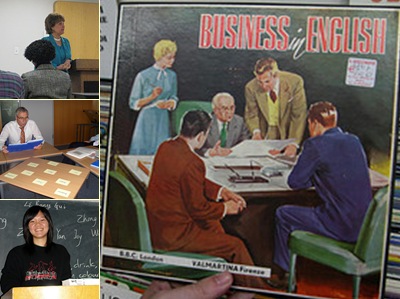
Now, there's nothing innately wrong with the above pictures however to adequately reflect our student real-world experiences and to adequately prepare them to conduct global business, while speaking English, this is what they really should look like, as often as possible:
Cert IBET Certificate in International Business English Training, Cert ICT Certificate in Teaching with Technology + short courses in moodle, e-moderation, podcasting, e-networks, 2ndLife, webquests & blogs.
Offers a 3-month professional development course in the methodology, intercultural competence and technology of teaching a language in virtual classrooms using state-of-the-art synchronous Internet communication tools. They also have 2-3h live online workshops conducted by LANCELOT certified language trainers. These provide concise information about a special set of tools.
Combining face2face teaching with blended learning. Blended Learning, evaluating web based ELT materials, blogs and wikis, podcasting, interactive whiteboards, virtual learning environments and new technologies.
In-house Options:
a. Hire a teacher-trainer to work through the various web2.0 based tools with your teachers.
Contact me to see if I can come over and train your teachers (check out examples of my presentations here/sign in to LinkedIn to read my professional references here).
If I'm not available, I'm very "socially-networked" and therefore can easily point you in the direction of another good teacher-trainer or three!
b. Hire an experienced techie teacher and assign IT leadership (or give the task to one of your current employees). Pay him /her to get up to speed and get this senior teacher to train the rest of your teachers.
Whatever it is that you and your team do decide to do, just don't do this:
Last week I had a lovely time working with a group of English language teachers who came to the VHS in Ludwigsburg for a workshop entitled
Pepping Up Your Business English Course Book!
Our objectives included looking at different ways to increase student-centered learning in our EFL and ESP classrooms and on making lessons exciting even when the teacher is required to use a published material in their curriculum.
The slides from my presentation are at the bottom of this posting. If you were there, you can use these to refresh your memory of some of the points we went through during our workshop and if you weren't, as you’re an EFL teacher too, you’re welcome to have a look and learn with us.
Do feel free to ask or answer questions!
We Asked the Question: Why Do Textbooks Need Supplementing?
You suggested things like they aren’t timely, they aren’t topical, sometimes they’re years and years out-of-date.
The books are sometimes very dull. Too much reading or too little reading. The role plays aren’t authentic or interesting.
The subjects don’t have anything to do with our students actual lives, professions or responsibilities. They’re generic – one size fits all. Sometimes a bit patronizing.
Vocabulary presented often isn’t the vocabulary our students are looking for. There’s very little review of vocabulary from unit to unit.
Not enough speaking activities.
What do you think?
Do you agree with our conclusions?
Then We Did a Study Of Multiple Intelligence:
And looked at images of
JK Rowlings
Stephen Hawking
Columbus
David Beckham
Ray Charles
Prince Charles
Barack Obama
Goethe
Dalai Lama.
In what ways are they all intelligent people?
We marveled at David Beckham’s enormous ability to not only get a ball to curve but that he is able to understand his body so well to make it move where he needs it to, his intelligence understanding the size and distance of a football field: intelligences none of us in the room could say we possess!
Have a look at the names on the list, who is intrapersonally intelligent?
Which ones are interpersonally, spiritually, musically, spatially, mathematically, verbally, naturalistically intelligent?
Do you think that intelligences overlap? Is there a 10th intelligence? What might that might be?
Hint: All 9 of the above examples probably have it – Prince Charles might be the debatable one…although given his recent talks on climate change – hmm, he fits too!* answer at the bottom.
What about the learning styles?
What role might this play in our classrooms?
We discussed what we would have to do if we were the English teachers of Beethoven, Miles Davies or Louis Armstrong and had to teach them Business English!
Next We Reviewed the Practices Of Teaching Business People Business Skills In English:
What are we teaching our students? Don’t they know more about Business than we do? Shouldn’t we be focusing in on their knowledge, simply giving them the language to perform as well as they normally do?
What is it that they want to learn? How are we teaching this to them?
Are we paying enough attention to who our learners really are?
After That We Analyzed Supplementary Materials:
What is available from the Publishers, from ELT websites – which would we use, why these?
What are the intrinsic strengths in each exercise, what weaknesses lie therein; any opportunities? Are there any changes you’d make to the material, why?
Are they all feasible - with which kind of groups – what learners are they aimed at?
We Were Also In Awe Of Ronaldo Lima’s Very Impressive Class (who are blogging):
What happens when students choose to write articles and then see themselves published for the world to see?
Pop over there for a visit, http://finally5b.blogspot.com/ ask or get your students to ask his students how they do it & do let them know what you think!
Then I Showed Everyone The Products I Make Myself:
SimplyConversationsTM and SimplyQuestsTM:
What is the target group of SimplyConversations? What type of learners, what kind of intelligence?
Why are they fun to use? What sorts of skills do they activate?
How do students feel about doing 1.5hrs of strictly conversation?
What effect does choosing their own tasks in the SimplyQuests have when they’re doing their post-task activity (a.k.a homework)?
And Finally We Made An Action PlanFor Future Lessons
What will you be doing to pep up your Business English courses?
Don’t hesitate to continue the communication with me by clicking on comments (at end of posting).
Thank you for coming Sibylle, Christine, Birgit, Wilfriede, Irmgard, Sandra, Jim, Stormy, Ines, Eva, Elizabeth, Veronique, Helmut and Maulina! Thanks VHS Ludwigsburg for organizing the event and hosting us. Am looking forward to continuing learning, growing and sharing with you.
*The 10th intelligence proposed above is visionary: the person who is not only able to 'see' into the future but knows what to do with the way things are changing. Of course, this intelligence is hotly debated as to whether it is an intelligence, as is spiritual and naturalistic intelligence.
There are others too, of course. Read more about multiple intelligences here (lots of links).
On April 1st, 2009, over 1600 teachers and academics from around the world will descend on Cardiff for the annual conference of the International Association of Teachers of English as a Foreign Language (IATEFL).
The conference boasts an international line up of world-class plenary speakers;
There will be over 400 talks, workshops, symposia and the event offers a state of the art exhibition of teaching materials, as well as a rich social program with a distinctly Welsh flavour. This year, 93 different countries will be represented at the event, making it a truly international occasion.
Delegates hail from as far as Vietnam, Venezuela, Cameroon and Micronesia.
However there are many thousands of professionals for whom attending the conference is usually no more than a dream because of the costs involved in travel to UK.
Therefore this year the event is being made accessible to thousands more participants from all around the globe through a virtual community space, known as ‘Cardiff on-line.’ This exciting and ground-breaking innovation is possible due to a collaboration between IATEFL and The British Council and is in line with their aim to link and support English language professionals worldwide.
The event, April 1 - April 4th 2009, is expected to be one of the biggest global teacher development events ever.
A large team will be in place behind the scenes to bring the workshops and speeches to remote audiences. Any teacher, anywhere in the world, from Mongolia, Nepal or Ethiopia to Germany, the USA and Japan will be able to sign up and participate for free in the conference from their own country.
All they'll need is good internet access, a computer and preferably a headset. All the plenary talks, as well as a sizable number of other presentations will be shown live over the Net, recorded and also made available on the conference site for later viewing.
There are also numerous forums discussing all aspects of the EFL profession, (already very active and engaging) photo albums, chat sessions and prizes!
While browsing around the net, following one link after and another, I landed up in a Ning group called Classroom 2.0 which I promptly joined as the members there clearly know a lot about the various teaching practices using technology.
One of the pages I visited was a blogger called David Truss who writes a blog called A Pair of Dimes. He has created a beautiful video called the brave new world.
So after my personal-story-rant on why EFL teachers should really start using technology (here) in their classrooms, I thought it’d be fitting to use this as part of the Monday tech-tips series.
He’s agreed to let me post it up here and I really hope you enjoy it as much as I have!
Now come on and join those of us producing dynamic lessons, interesting, pedagogically sound materials –there is a shift in education happening today and I do hope you want to be a part of it.
There are a lot of tools and a lot to learn (see article here) so every Monday I’ll add one more tip and we’ll get you there, bit by bit.
If you just read the posting above on how important motivation is as a factor in teaching fluency to your language learners and you watched the video of my class in a brainstorming session then you’ll have seen that the Sundance film festival was one of our scheduled topics.
Here’s a look at the short we watched and discussed:
"Validation" is a fable about the magic of free parking. Starring TJ Thyne & Vicki Davis. Writer/Director/Composer - Kurt Kuenne. Winner - Best Narrative Short, Cleveland Int'l Film Festival, Winner - Jury Award, Gen Art Chicago Film Festival, Winner - Audience Award, Hawaii Int'l Film Festival, Winner - Best Short Comedy, Breckenridge Festival of Film, Winner - Crystal Heart Award, Best Short Film & Audience Award, Heartland Film Festival, Winner - Christopher & Dana Reeve Audience Award, Williamstown Film Festival, Winner - Best Comedy, Dam Short Film Festival, Winner - Best Short Film, Sedona Int'l Film Festival.
Every Monday, I’ll kick off the week by posting up a training video or a slideshare on technology and the English Language Classroom.
To start us off we’ll be looking at this video from the Commoncraft show on hardware.
Knowing how the computer works will help you understand all the other stuff you’re doing on it!
Don’t hesitate to let me know if you like(d) the video or if there is anything else in particular you would like to see. Simply click on the comments to communicate with me.
I was browsing around in youtube last night and came across a video from a Columbian youth.
The question was so poignant I immediately knew it would make a great lesson.
Today in Davos, the World Economic Forumbegins. To support their activities, other than their website, the WEF have also created an interactive page on youtube for questions and lectures on a number of topics including economy, ethics, environment and politics.
Pablo's answer to the question Should CEOs have a code of ethics was:
You can download the video from here. Not sure how to take it into class, come here.
I know I'm 100% for this idea, my feelings are "about time" -but what do our business English students think?
Here's a quick lesson plan - don't hesitate to add to it or suggest other uses for these rich and interesting discussions.
ask students if they know what a "code of ethics" is
get them to list professions that have one
doctors, psychologists, lawyers, journalists, social workers and more
write on the board - Should CEOs have a code of ethics? Ask why, why not?
watch the video (possibly more than once depending on your students' levels)
review some of the more difficult vocabulary* (see below, you could also pre-teach)
hold a discussion on the suggestions he makes, feasible?
provide students with these codes of ethics: doctors and lawyers
Quite long: you can split these up into parts or only use some of it, do a google search for others if you have a large class.Different codes to different students.
provide this guideline on creating a code of ethics, c.o.e. (or adapt)
get students to brainstorm a new code specifically for CEOs in groups
encourage them to use some of the 'legal-speak' they've picked up so far
choose a presenter from each group to relay their c.o.e, edit as necessary
discuss the pros and cons of their suggestions
Important vocabulary
to be contingent on, to standardize, to compromise
unethical liberties, human rights, common characteristics, profit-driven
an international code, international markets
Post-task activity
Let your students choose between watching further videos on youtube, listening to podcasts or reading articles, blog postings etc on the WEF and ask them to report back on their activities next week (or next lesson(s)).
You could also ask them to research the people present or behind the scenes. Alternatively, you can also ask your students to look into the history of the Forum and the location chosen.
Or, if you're lucky enough to be teaching a group with great technology skills, teens /youth perhaps, why not get them to make video responses on their cameras or camera phones and actually participate in the debates - such fun!
Best, Karenne p.s don't forget you can .pdf this page or send it to yourself/ a friend. Buttons below.
Do you occasionally use news articles with your English language students?
Do your prefer using newspapers or do you like searching for articles on-line?
I used to use the articles from the Guardian Weekly (about once a month there's a lesson or two enclosed) however, these days I tend to prefer the stuff that's on-line.
TheBBC's Learning English site has lessons bundled together with vocabulary activities. Often the topics they've chosen aren't that interesting or, surprisingly, not that topical either!
There are also a couple of sites which utilize news stories to springboard more in-depth discussions and active conversations.
Languages Out There- materials which go way beyond just reading and looking at vocabulary. Challenging speaking activities - much different from the norm.
*if you'd like to recommend a site related to this theme, don't hesitate to add it below.
However if you've checked through these and unfortunately haven't found what you're looking for or you're simply in the mood for putting together your own news lesson, then here's a quick techie-sort-of-tip for you below.
PREP (10-15mins):
Go to Google, look at the top bar and click NEWS.
Make sure your computer is set for Google.com (in English).
Look at the left-hand side of the screen where it reads Top Stories >World >US >Business >Entertainment etc.
Click on one or all of these and choose one article for each student you have. Choose stories you know are currently in the popular papers of their countries, if possible, or articles related to their professional fields. Print.
PRE-DISCUSSION
Hand out a news story to each member of your class.
Ask them to scan the article for content and also to highlight INTERESTING words and phrases. Make sure they understand that
they don't have to understand every word, they should focus on the story.
Stop them after a reasonable amount of time has passed.
DISCUSSION
Break your students up into small groups and get them to share each others' stories.
Encourage them to use the words and phrases they highlighted when paraphrasing.
POST-DISCUSSION
Ask students to transfer the highlighted words and phrases that are useful to their lives/professions or interests into their notebooks.
Have you realized how poignant that old favorite, sung by Abba way back when, is?
Ideal for taking into class with you at the beginning of term.
Here's a quick little exercise that you can print off and drag in as an ice-breaker or warmer.
Instructions
distribute sheet
tell class to fill in as much of the blanks as they can, then
play song, first time straight through without stopping
get them to check with each other and compare answers
play song, second time stopping after each sentence
compare answers
discuss key vocabulary
discuss meaning of the song and 'the time' it was sung in
SimplyConversations Extension
the gap fill basically works on a 'lexical chunk' system in order for you (your students) to pay particular attention to the way words group together. If you're working with a group of fairly fluent and motivated students you can also use this activity as a philosophical discussion tool. ABBA sung this pre-internet, pre-a lot of other things and older students who were around when this was a hit will have much to add to the pot.
Video of this song
The official ABBA site has a gorgeous video with lyrics on screen. That's here. More songs related to the new year on youtube here.
Have you been a good English language teacher this year? Have you been learning and growing, communicating, aiding, facilitating, coaching and generally imparting your knowledge of this wonderful language?
Good, you deserve a treat and so you can have a quick chat with Santa, I'm gonna tell you about the most important thing I bought this year.
As I've mentioned often, he's the number one love of my life.
Actually, I confess, when I hit the "create a new post" button I thought I'd begin this with a poem, an ode in fact, but realized that
The Little Blue Guy
I traveled from shore to shore visiting each and every store wasn't sure what to do I needed to find you.
My back was killing me - my laptop, you see weighs a ton! But teaching with technology's so much fun. Had a quick look you're the size of a book I fell in love: you fit in my bag like a glove. Oh! You're shiny and new you're beautiful 'n blue I immediately knew what to do - I bought you.
well, Puh! That's simply just too corny.
You'd probably prefer to just read the statistics, get the hard facts and data and get told how to go find your own.
Rightie, then.
The Little Blue Guy's real name is an Acer Aspire One.
He's one of a genre of netbooks currently on the market. Mine cost €399 a couple of months ago however shortly after purchasing, noticed that Amazon had him at €50 less. Hmmm... you live, you learn. I never reckoned that buying electronic equipment would be cheaper online but there you go. (Links below.)
In general, Netbooks range from €299 to €699.
At the lower end of the price range they are pre-installed with the operating system Linux. Unfortunately, despite what all the techie geeks say I'm going to tell you that if you're not a SuperTechie and don't have a SuperTechie spouse, in the house, then don't go there.
It's simply too time-consuming to figure out how to make the video functions work or utilize some of the great free downloads available. I know, I tried and ended up going back to the shop to get the Acer.
If you're a regular ELT (English language teacher) currently in the process of moving over to TwIT (Teaching with Technology) and you'd like to have your own little guy, you'd be better off going for a model with XP.
And don't worry, those abound. Here are two good, short videos, one's cute marketing propaganda and one's a review of four models .
The Acer shown by the guy in this video uses Linux, again: look for one with XP pre-installed. The main reasons, as you probably gleaned from my poem and the vid, for using netbooks to teach English in the classroom/ in-company are:
they are portable and practical
light (1.8kg - 3.1kg)
small (7" - 10")
and in many casesthey
come with more memory than a normal laptop (120-160GB compared to 80GB of most models).* -be careful, some only have 8GB: not useful if you want to download and save videos.
are often more powerful than a normal laptop
Do note that these machines aren't meant to replace your laptop or your desktop computer at home. If you spend hours typing on one of these your fingers and wrists will end up hurting!
It's a mini computer, made specifically for infrequent and internet usage - perfect for taking into class, to training conferences if you're a teacher trainer, for showing videos, playing mp3s & podcasts, recording your students and sharing presentations you've made or grabbed from slideshare.
Some downsides you should also consider:
no DVD or CD slot
you will need to purchase or download free software separately.
the touchpads are small (best to get an extra mouse to go with and if you want to walk around the classroom while controlling what's going on the screen, get a 'presenter' mouse.)
Want Santa to come on down the chimney? Get the banker of your household (if you have one) to have a general browse around at what's available in your city. It's a good idea to compare prices - also come on over and take a look at my Amazon "toys for teachers" pages where I've presaved some good models
p.s. if you want your operating system to be in English and your country allows importation of computer goods, best to go with a purchase from UK or US.
On The Little Blue Guy, I've put the following useful freeware:
Do you have observations or experiences you'd like to share with us about the model you chose and how it works? Don't hesitate to click on the green comments at the bottom and type in your message there.
Best, Karenne
p.s. Lindsay Clandfield's new blog is up and he's got a list of six more gift ideas for teachers, they're over here.
New to Twitter and wondering who else to follow? @Beltfree feeds 100+ ELT blogs and here's a Twilist of gr8 ELTeachers plus why not join us in #ELTchat (Wednesdays).

 I had something very different scheduled for today.
 education




 Posts
Posts


